
Stop Writing Boring Blogs: Why Building Free Tools is the Ultimate SEO Hack in 2026
Author
Muhammad Awais
Published
May 11, 2026
Reading Time
5 min read
Views
169
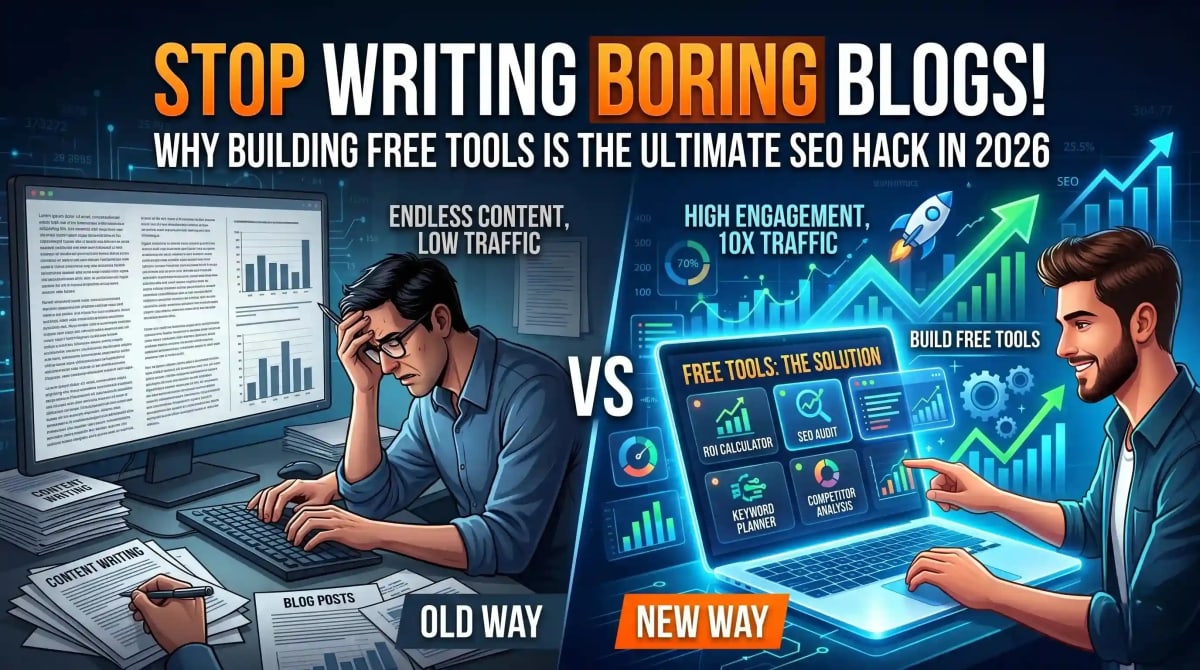
Let's face the harsh reality of the web in 2026: The internet is completely flooded with AI-generated content. Everyone and their grandmother is using advanced language models to pump out 2,000-word articles that nobody actually wants to read. As a result, Google's algorithm has aggressively evolved. It is actively penalizing generic "how-to" blogs and heavily rewarding sites that provide genuine, interactive value. If you want to rank on the first page today, you need to stop writing boring blogs and start building free tools.
The Death of Traditional SEO & The Rise of SGE
Just five years ago, you could write a lengthy article titled "10 Ways to Convert WebP Images" and rank it easily with a few backlinks. Today, that exact query returns a Google AI Overview (Search Generative Experience) that answers the question instantly at the very top of the page, giving the user absolutely zero reason to click on your website. Informational keywords are essentially dead for independent creators and small blogs.
Users in 2026 have zero attention span. They do not want to read about converting an image or formatting code; they want a highly responsive interface with a button to click and get it done instantly. This massive behavioral shift has given rise to the ultimate organic growth strategy for modern developers: Engineering as Marketing.
Engineering as Marketing: The Micro-Tool Era
Engineering as Marketing is not a new concept, but it has become the gold standard. It means building small, highly focused utilities (micro-tools) that solve one specific, painful problem perfectly, and offering them entirely for free. But why does this work so effectively for SEO?
Insane Dwell Time: When a user interacts with a tool, they are actively engaged. They are uploading files, typing text, or adjusting sliders. They stay on your page for minutes, not seconds. Google's algorithm sees this massive "Time on Page" metric and skyrockets your domain authority.
Zero Bounce Rate: Tools naturally force the user to interact. Clicking buttons or copying generated text signals to search engine crawlers that your page is highly engaging and effectively answers the user's search intent.
Natural Backlinks & Viral Sharing: People share useful tools on Reddit, Twitter (X), HackerNews, and private developer discords far more often than they share standard blog posts. A solid tool becomes a bookmarkable utility.
The Psychology of Micro-Tools
To understand why this strategy dominates, we have to look at the psychology of the modern web user. We live in a dopamine-driven, instant-gratification economy. When a user is frustrated perhaps they need a stylish font for their Instagram bio or they need to compress a massive banner image they are experiencing friction. A blog post introduces more friction by forcing them to read. A tool removes friction instantly.
When your web application solves their problem in under two seconds with a clean UI, you trigger a positive psychological response. That user will remember your brand. The next time they need a developer utility, they won't even search Google; they will type your URL directly into their browser. Direct traffic is the holy grail of website valuation.
Case Study: The WebToolsHub Ecosystem
Instead of writing a 3,000-word essay on Instagram typography, we built a tool that actually solves the problem in milliseconds using pure client-side processing.
Try Fancy Font Generator See WebP Optimizer
Building for Scale: Next.js and TypeScript
Whether you are a junior coder or an Associate Full Stack Developer building production-ready features, you are sitting on a goldmine. You do not need a massive marketing budget or a dedicated SEO agency. You just need a modern stack like Next.js, TypeScript, and MongoDB, combined with a decent UI framework like Tailwind CSS, and a free weekend.
The beauty of the Next.js App Router in 2026 is that you can build highly complex, client-side tools that require zero backend processing. For example, our tools utilize the browser's native HTML5 Canvas API and Unicode mapping dictionaries. This means zero server costs, zero database bloat, and instantaneous results for the user.
If you notice frontend developers struggling with messy vector graphics, don't write a theoretical tutorial. Build an interactive SVG to JSX Converter. If React developers are constantly complaining about hydration mismatches, provide a diagnostic tool or a comprehensive, actionable technical guide like our viral post on Fixing Next.js Hydration Errors. Combine utility with targeted knowledge.
Monetization: Skyrocketing Your AdSense RPM
Let's talk about the bottom line: Revenue. Standard blogs often suffer from low RPMs (Revenue Per Mille) because users scroll to the bottom and immediately leave. Micro-tools change the entire monetization landscape.
Because users are spending more time on your page interacting with your tool, ad networks like Google AdSense have the opportunity to serve higher-paying, dynamic ads. A user generating 50 different fonts or compressing multiple images will trigger ad refreshes and viewability metrics that traditional content simply cannot match. You are effectively printing money while providing genuine, free value to the community.
Conclusion: Build, Don't Write
The message for the future of the web is crystal clear: adapt to utility, or be buried by AI. The SEO landscape of 2026 belongs entirely to the builders. Text has become cheap and commoditized, but custom functionality remains premium. By transforming your website from a passive reading experience into an active, interactive tool suite, you don't just win Google's algorithm you win a loyal user base that comes back every single day. Start planning your first micro-tool today, write the code, ship it fast, and watch your organic traffic multiply.
Tagged in
Continue Reading
All Articles

Level Up Your Workflow
Free tools mentioned in this article
Tailwind Bento Grid Builder
Build responsive Tailwind CSS Bento Grid layouts visually drag, resize, and export clean React JSX or HTML code instantly. No coding needed.
Unix Timestamp Converter
Convert Unix timestamps to readable dates and back instantly. View the current epoch time, convert any timestamp, and see results in any timezone.
Stripe & PayPal Fee Calculator
Calculate the exact Stripe and PayPal transaction fees for US and UK markets. A free developer tool to estimate SaaS payouts, merchant costs, and revenues.
Regex Tester & Debugger
Test, debug, and validate JavaScript regular expressions instantly. Live match highlighting, capture groups, all flags supported - free, client-side, zero logs.