
Programmatic SEO: How to Generate 10,000 Pages in Next.js
Author
Muhammad Awais
Published
May 13, 2026
Reading Time
7 min read
Views
7k
The Zapier Playbook: Hacking Scale
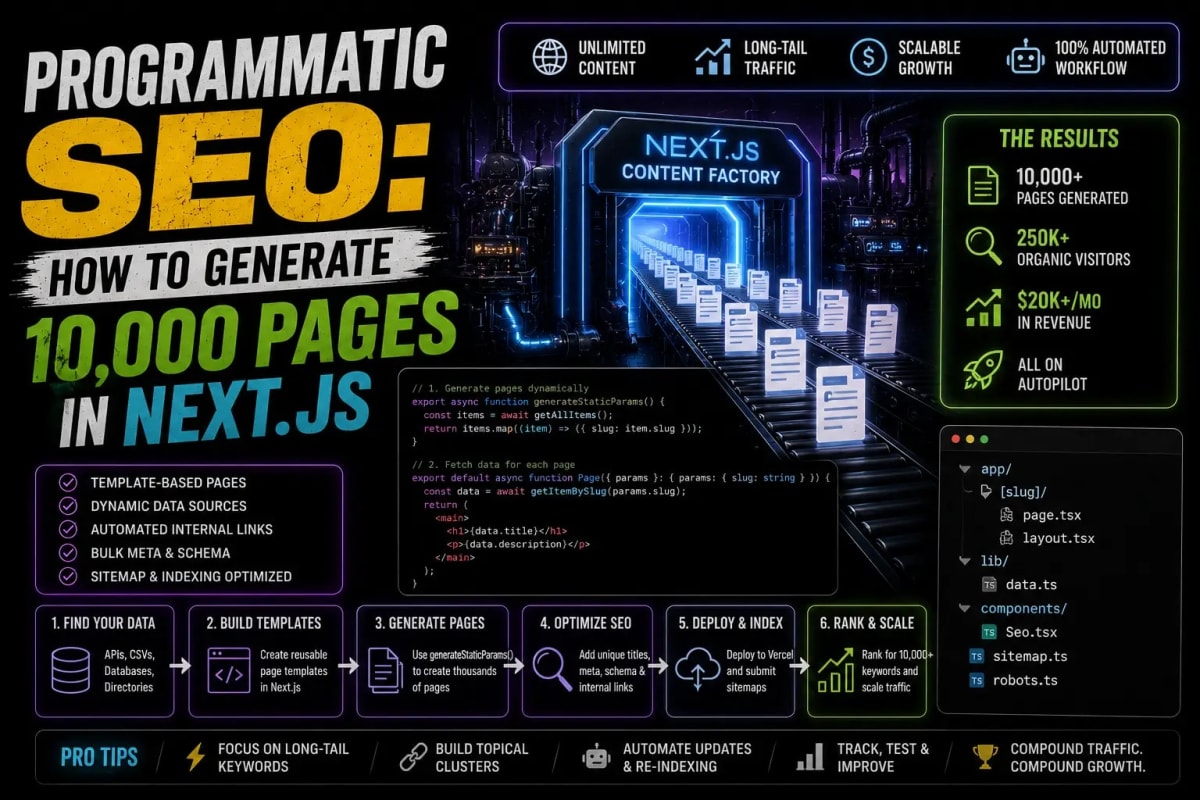
If you look closely at the most successful software companies in the world, you will notice a fascinating pattern. When you Google "How to connect Gmail to Slack", the first result is a Zapier landing page. If you Google "How to connect Trello to Google Sheets", the first result is also a Zapier landing page. Did a human content writer sit down and manually write thousands of individual blog posts for every possible software combination on Earth? Absolutely not. That would take centuries. They used Programmatic SEO (pSEO). They built a single, highly optimized React template, connected it to a massive database of software names, and generated 100,000 unique landing pages dynamically. In 2026, writing content manually is a luxury; generating it programmatically is a necessity. Today, we will uncover exactly how you can replicate this million-dollar marketing strategy using the Next.js App Router.
What is Programmatic SEO?
Programmatic SEO is the methodology of using code to automatically create large quantities of landing pages tailored to high-volume, low-competition search queries. It relies on finding a specific "Head Keyword" and combining it with a massive dataset of "Modifiers."
For example, if you are building a real estate SaaS platform, your head keyword might be "Best real estate agents in..." Your modifiers are a database of 5,000 different cities across the country. By merging these together via a dynamic route (e.g., /agents/[city]), your Next.js application instantly spins up 5,000 unique URLs: /agents/new-york, /agents/chicago, /agents/austin. Suddenly, you have a massive footprint in Google's search index without writing a single line of traditional copy.
The Hard Truth: Escaping the Spam Filter
In the early 2010s, developers abused this strategy. They would spin up 10,000 pages of identical, spun text where only the city name changed. In 2026, Google's Helpful Content Algorithm will instantly detect this "Doorway Page" spam and de-index your entire website within 48 hours. To succeed at pSEO today, your pages must offer high 'Information Density' and unique value.
You cannot just change the H1 tag. Your template must dynamically pull in unique datasets for each page. If the page is about New York, it must display the average housing prices in New York, the weather, and a list of local neighborhoods. This requires complex data pipelines and perfectly typed JSON APIs.
The Architecture of Type-Safe Data
When you are rendering 10,000 pages programmatically, a single missing data field in your JSON response can crash the entire build process during deployment. You cannot afford runtime errors at this scale. Senior engineers solve this by copying their target dataset (from an external API or Postgres database) and running it through a JSON to TS Converter. By strictly defining the TypeScript interfaces for your massive datasets, Next.js can mathematically guarantee that every single one of your 10,000 pages receives the exact data structure it needs to render without failing.
Designing the Master Template
Because a single React component (e.g., page.tsx inside a dynamic route) will dictate the layout of thousands of URLs, it must be an absolute masterpiece of UI/UX design. It cannot look like a boring spreadsheet dump. It must look like a premium SaaS dashboard.
The most effective layout for pSEO pages is the Bento Grid. It allows you to ingest massive amounts of raw JSON data (charts, statistics, bullet points) and display them in distinct, digestible visual cards. Instead of spending weeks attempting to build a responsive master template from scratch, smart developers use a Tailwind Bento Grid Builder. You visually arrange where the dynamic title goes, where the statistical charts go, and where the CTA (Call to Action) sits. Once the structural grid is flawless, you simply map your dynamic data into the specific Bento boxes.
Media Optimization at Scale
One of the most devastating technical challenges of pSEO is media handling. If your dynamic route generates 5,000 pages, and each page has a unique high-resolution header image (e.g., a photo of the specific city), your server is suddenly burdened with serving 5,000 massive JPEG files. If Google's crawler bot hits those pages and they take 4 seconds to load, your entire programmatic strategy will fail due to Core Web Vitals violations.
Before you inject any dynamic image links into your database, you must batch-compress the entire library. Utilizing an Image to WebP Optimizer is absolutely non-negotiable at this scale. By converting thousands of 3MB JPEGs into 50KB WebP files, you ensure that even when Google's bot crawls 100 pages per second, your server responds instantaneously, securing your perfect Lighthouse speed scores across the entire programmatic footprint.
Surviving AI Search & Generative Answers
Generating the pages is only half the battle. In the current era of Zero-Click searches and AI answer engines, simply existing in Google's index is no longer enough to guarantee traffic. You must ensure that your programmatically generated data is structured in a way that Large Language Models (LLMs) like ChatGPT or Perplexity can ingest and cite.
This means your pSEO strategy must evolve into a GEO (Generative Engine Optimization) strategy. You must inject robust JSON-LD schema markup into every dynamically generated page. If your page is a directory of tools, the schema must declare it as a 'SoftwareApplication'. If you want to understand how to format your code to become the primary citation for AI bots, you must read our deep dive on Generative Engine Optimization (GEO). When you combine the massive scale of Next.js pSEO with the semantic structuring of GEO, you create an unstoppable organic traffic engine.
Conclusion: Code as Leverage
Naval Ravikant famously said, "Code is leverage." Programmatic SEO is the ultimate manifestation of that quote. Why trade your valuable time writing one blog post when you can write one script that generates ten thousand? By mastering Next.js dynamic routing, ensuring strict type safety for your data pipelines, optimizing your programmatic media, and designing flawless Bento layouts, you transition from being a simple web developer into a digital growth hacker. Stop writing. Start generating.
Growth FAQ
Will Google penalize my site for having too many auto-generated pages?
Google only penalizes 'Thin Content' or spam. If your 10,000 pages provide genuine, unique value to the user (e.g., specific data, distinct comparisons, unique images) that cannot be found elsewhere, Google will index and reward them. Quality and Information Density are the shields against penalties.
Where do I get the datasets for Programmatic SEO?
There are three main ways: 1) Public APIs (like weather, crypto, or government data), 2) Web Scraping (using tools like Puppeteer to extract data from existing directories), or 3) Proprietary Data (data generated by your own users, which is the most valuable and SEO-proof).
Should I use Server-Side Rendering (SSR) or Static Site Generation (SSG) for pSEO?
In Next.js 14, you should almost always use Static Site Generation (SSG) via the 'generateStaticParams' function for pSEO. This pre-builds all 10,000 pages into static HTML at build time, resulting in instantaneous page loads and minimal server costs compared to SSR.
How long does it take for 10,000 programmatic pages to rank on Google?
It requires patience. Google has a 'Crawl Budget'. It won't index 10,000 new pages on a new domain overnight. It typically takes 3 to 6 months for a massive programmatic build to be fully crawled, indexed, and stabilized in the search rankings. Creating a comprehensive XML sitemap is mandatory to speed up this process.
Tagged in
Continue Reading
All Articles
Level Up Your Workflow
Free tools mentioned in this article
JSON to TypeScript Converter
Convert any JSON object into clean TypeScript interfaces instantly. Supports nested objects, arrays, and optional fields free, no signup, runs entirely in your browser.
Tailwind Class Sorter
Sort Tailwind CSS classes instantly using Prettier's official order. Paste plain classes, HTML, or JSX get clean, sorted output in one click. Free, no signup.
SVG to JSX / TSX Converter
Transform raw SVG code into production-ready React (JSX/TSX) components. Features camelCase mapping, Tailwind support, and TypeScript prop generation.
JWT Secret Key Generator
Generate cryptographically secure, high-entropy JWT secret keys instantly. A free, client-side CSPRNG key generator for secure HS256 and HS512 tokens.