
The Subscription Fatigue: Why Free Tools Make More Money Than Paid SaaS in 2026
Author
Muhammad Awais
Published
May 11, 2026
Reading Time
6 min read
Views
291
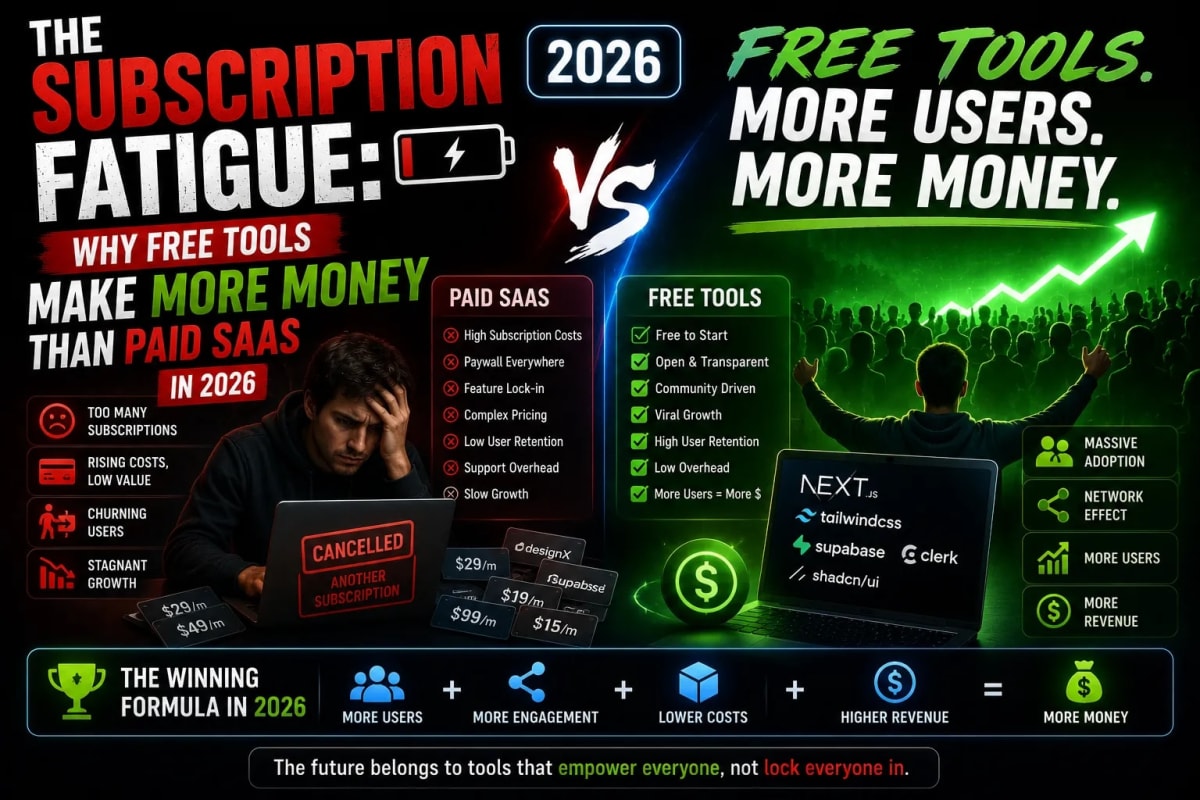
If you are an indie hacker or a solo developer in 2026, you have probably been sold a very specific dream: Build a Micro-SaaS, slap a $15/month Stripe subscription on it, acquire 1,000 customers, and retire to a beach in Bali. It sounds incredibly enticing, but the harsh reality of the modern internet is vastly different. We are currently living through the peak of "Subscription Fatigue." Users are utterly exhausted by monthly recurring charges. Unless your software is a mission-critical B2B enterprise tool, convincing a casual user to pull out their credit card is nearly impossible. It is time to pivot. Let's explore the business strategy of the future: why building highly-trafficked, 100% free utility tools generates significantly more revenue than struggling to build a paid SaaS.
The Psychology of Subscription Fatigue
Think about your own bank statement. You are paying for Netflix, Spotify, Amazon Prime, ChatGPT Plus, GitHub Copilot, and perhaps a dozen other small subscriptions. When a user lands on a new website to perform a simple task like converting a file or generating a graphic, and they are hit with a paywall, their immediate psychological response is resentment. They hit the back button and look for a free alternative.
The friction required to convert a free visitor into a paying subscriber is monumental. You need a flawless landing page, a highly persuasive onboarding sequence, customer support infrastructure, and a robust refund policy. For a solo developer, managing this friction takes time away from actual engineering. When you remove the paywall, you remove the friction. Your adoption rate skyrockets from 0.5% to 80% overnight.
The Mathematics of "Free"
How does giving something away for free make more money? It all comes down to the mathematics of traffic volume and high-RPM (Revenue Per Mille) advertising.
Let's look at a hypothetical scenario. You build an advanced QR Code application. You decide to charge $5/month. After six months of aggressive marketing, you manage to convince 50 people to pay. You are making $250 a month, but you are spending 20 hours a week answering customer support emails about failed Stripe charges.
Now, look at the WebToolsHub approach. We built an Advanced QR Code Generator with features that competitors charge for (like VCard generation and logo embedding), and we made it 100% free. Because it is free, users share it on Reddit, bookmark it, and link to it from their blogs. Instead of 50 users, the tool gets 150,000 visitors a month. With a highly optimized tech-niche AdSense RPM of $15, that single free tool generates $2,250 a month in completely passive, zero-support revenue. Volume always wins.
Case Study: Disrupting Paid Markets
The easiest way to find a winning idea for a free tool is to look at what other companies are successfully charging for, and commoditize it. For instance, typography and social media branding tools often hide their best features behind premium tiers.
By launching a completely free Fancy Font Generator that requires no login and no credit card, you instantly siphon traffic away from the paid competitors. The users get exactly what they want instantly, and you monetize their attention via premium programmatic ad placements.
The SEO Moat of Utility Networks
Building a single free tool is a great start, but the real enterprise value comes from building an ecosystem a "Utility Network." When a user visits your site to use an Image to WebP Optimizer, they naturally notice your sidebar linking to your other developer tools, like your SVG converters or TypeScript generators.
This creates an incredibly sticky user experience. Google's algorithm tracks how long a user stays on your domain and how many pages they visit (Session Duration and Pages per Session). A highly interlinked network of free tools sends massive positive signals to search engines. As your Domain Authority (DA) rises organically, every new tool you launch automatically ranks on the first page of Google, creating an unstoppable flywheel of organic traffic.
Beyond Ads: The B2B Sponsorship Model
While Google AdSense provides a fantastic baseline of passive income, the true revenue explosion for free tools comes from direct B2B (Business-to-Business) sponsorships. When you build a tool that solves a specific problem for a specific demographic, you aggregate highly targeted attention.
If you have a developer utility that converts CSS to Tailwind, getting 50,000 developer eyeballs a month, you don't need programmatic ads. You can directly approach companies that sell developer tools (like Vercel, Supabase, or AWS) and sell a native, non-intrusive sponsorship banner for thousands of dollars a month. Brands are desperate for high-quality developer attention, and utility tools are the purest form of that attention.
Frequently Asked Questions (FAQs)
Doesn't hosting a free tool cost too much money if it goes viral?
It depends entirely on your system architecture. If your tool relies on expensive backend APIs, yes, a free tool can bankrupt you. However, as we discussed in our Client-Side Processing Guide, if you push the computation to the user's browser using WebAssembly or Web Workers, your server costs remain practically zero, regardless of traffic volume.
Is the "Free Tool" market too saturated in 2026?
Mediocre tools are saturated. There are a million poorly coded, slow calculators on the web. However, there is a massive shortage of high-quality, beautifully designed, incredibly fast utility tools that respect user privacy. Quality and User Experience (UX) are your ultimate differentiators.
How do I get my first 1,000 users for a free tool?
Launch where your audience hangs out. For developer tools, Product Hunt, Hacker News, and specific subreddits (like r/webdev or r/nextjs) are goldmines. Because you are offering genuine value for free with no paywall, community moderators are far less likely to flag your post as spam compared to a paid SaaS pitch.
Conclusion: Commoditize Your Code
The golden era of the $15/month solo SaaS is fading, replaced by the era of the high-traffic Utility Ecosystem. By stepping away from the subscription model, you eliminate customer friction, drastically reduce support overhead, and open the floodgates to massive organic traffic. Commoditize the features that others charge for, prioritize zero-cost client-side architecture, and let programmatic ads and direct sponsorships build your passive income empire. Build tools, keep them free, and watch your revenue scale.
Tagged in
Continue Reading
All Articles
Level Up Your Workflow
Free tools mentioned in this article
Bcrypt Generator & Verifier
Generate and verify Bcrypt password hashes instantly in your browser. A secure, client-side Bcrypt hash calculator for developers with zero backend logs.
HTTP Status Code Lookup
Look up any HTTP status code instantly 1xx to 5xx, Cloudflare codes, WebDAV, with JS/Next.js handling examples. Free, no signup.
Unix Timestamp Converter
Convert Unix timestamps to readable dates and back instantly. View the current epoch time, convert any timestamp, and see results in any timezone.
Stripe & PayPal Fee Calculator
Calculate the exact Stripe and PayPal transaction fees for US and UK markets. A free developer tool to estimate SaaS payouts, merchant costs, and revenues.